
Table of Contents
💡 Overview
An industrial powder bagging machine streamlines the process of filling and sealing bags with dry powders. By using automated weighing and auger systems, these machines ensure high precision, reduce product waste, and maintain hygiene standards. Selecting the right model depends on material flow, bag type, and required production speed.
Precision in packaging remains a primary concern for businesses dealing with fine materials. A high-quality powder bagging machine provides the necessary accuracy to ensure that every package meets weight requirements without significant loss of product. Whether you are handling flour, chemicals, or cement, the mechanical reliability of your equipment determines your daily output.
Understanding Powder Bagging Machine Categories
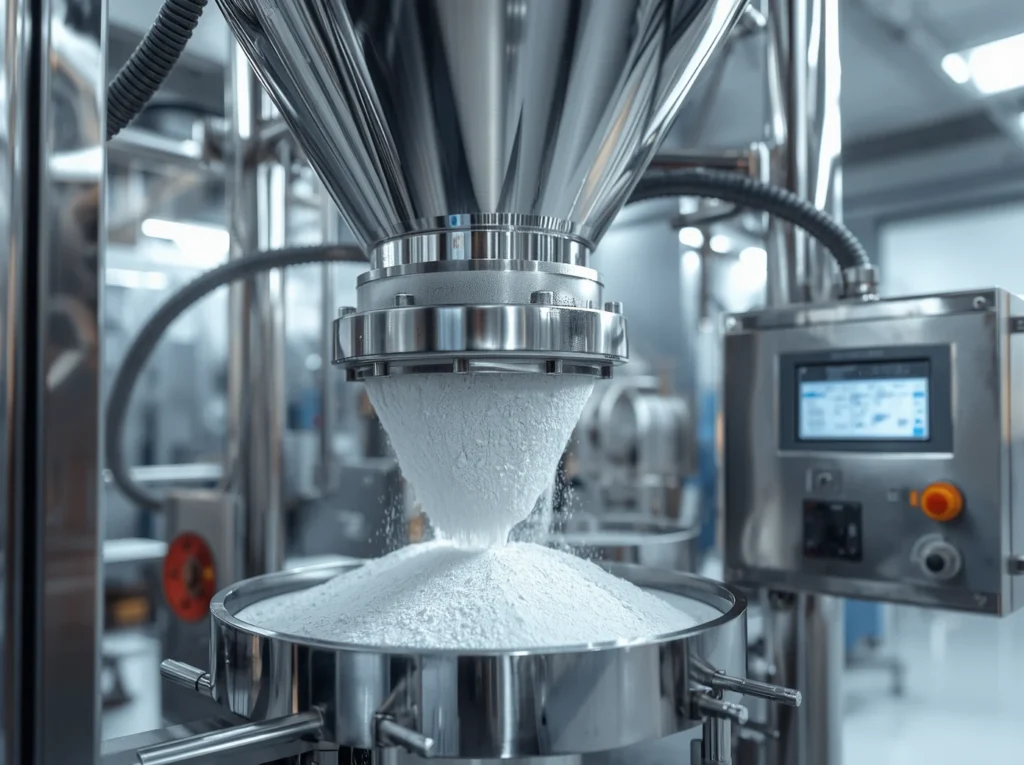
The market offers several designs tailored to specific material characteristics. Most powders do not flow like liquids, which means the feeding mechanism must be robust.
Auger Fillers for Non-Free-Flowing Powders
Non-free-flowing powders, such as flour or milk powder, tend to clump or bridge. An auger-based powder bagging machine uses a rotating screw to push a specific volume of material through a funnel.
Our team frequently finds that the pitch of the auger must be precisely matched to the powder density to prevent overfilling. By controlling the number of rotations, the system achieves consistent weight across thousands of cycles.
Net Weighing vs Gross Weighing Systems
For materials that flow more easily, gravity-fed or vibratory systems are common. Net weighing involves measuring the powder in a separate hopper before discharging it into the bag.
Gross weighing measures the weight as the bag is being filled. In our experience, net weighing systems are faster because the next load can be measured while the current bag is being sealed.
Technical Specifications and Performance Metrics
When evaluating a powder bagging machine, speed and accuracy are the most prominent metrics. However, dust control is a factor that often goes overlooked. Fine particles can escape during the filling process, leading to a dirty workspace and potential health hazards.
<p>| Feature | Semi-Automatic System | Fully Automatic System |</p&gt; <p>| :— | :— | :— |</p> <p>| Operator Involvement | High (Bag placement) | Minimal (Monitoring) |</p&gt; <p>| Speed (BPM) | 5 – 12 bags/min | 20 – 60+ bags/min |</p> <p>| Weight Range | 100g – 50kg | 1g – 25kg | (Baca juga: Mastering Production: The Power of an Automatic Bagging Machine</a>)</p> <p>| Accuracy | +/- 1% to 2% | +/- 0.2% to 0.5% |</p> <p>| Space Requirement | Compact | Large Footprint |</p>Choosing the right configuration depends on your current volume and your plans for scaling. If you are currently using manual labor, transitioning to a semi-automatic powder bagging machine can often double your output within the first week of operation.
If you need assistance determining which capacity fits your facility, feel free to Contact Us for a detailed technical consultation.
Operating Challenges in Powder Packaging
Working with dry materials presents unique difficulties. Based on our field tests, moisture content is the most common variable that disrupts production. Even a small increase in humidity can turn a free-flowing powder into a sticky substance that clogs the Auger filler mechanism.
Managing Dust and Cross-Contamination
In pharmaceutical or food applications, preventing cross-contamination is mandatory. A well-designed powder bagging machine features easy-to-clean contact parts made from stainless steel 304 or 316.
We often find that machines with “tool-less” disassembly save hours of downtime during product changeovers. Proper dust extraction ports should be integrated into the filling head to keep the environment clean and safe for workers.
Bag Compatibility and Sealing Integrity
The type of bag used—whether plastic, paper, or woven polypropylene—affects the choice of sealing technology. Heat sealers work best for plastic, while sewing machines are preferred for heavy-duty sacks.
Using a powder bagging machine with integrated sealing ensures that the product is protected from moisture and air immediately after filling, extending its shelf life significantly.
Maintenance for Long-Term Reliability
Consistent performance requires a disciplined maintenance schedule. Many operators ignore the wear on the auger screw or the calibration of the load cells until a failure occurs.
Routine Calibration and Parts Inspection
To maintain accuracy, the load cells of your powder bagging machine must be calibrated weekly. Vibration from the factory floor or temperature changes can shift the zero-point of the scales. Best practices from our team: check the drive belts and motors for signs of overheating or fraying every month. Replacing a worn belt is far cheaper than dealing with a motor burnout in the middle of a high-volume shift.
Software Updates and PLC Control
Modern equipment relies on Programmable Logic Controllers (PLCs). Keeping the software updated ensures that the machine can handle different recipes and weights with minimal manual intervention. If your powder bagging machine features a touch-screen interface, ensure it is kept away from excessive heat or direct exposure to abrasive powders that might damage the sensors.
PT Sentra Teknika Prima provides engineering solutions and equipment maintenance for various industrial needs. We focus on delivering mechanical parts and systems that withstand the rigors of continuous operation. Investing in a durable powder bagging machine is a move toward a more predictable and profitable production cycle.
FAQ
What types of bags can a powder bagging machine handle?
These machines can handle various materials, including plastic pouches, paper bags, woven polypropylene sacks, and aluminum foil bags, depending on the sealing mechanism installed.
How does the machine handle different powder densities?
An auger-based powder bagging machine uses different screw sizes and speeds to accommodate varying densities, ensuring the volume or weight remains consistent.
Is it possible to switch between different products on the same machine?
Yes, most machines allow for product changeovers. Models with quick-release parts make the cleaning and switching process faster to avoid contamination.
What is the average accuracy of an industrial powder bagging machine?
High-end automatic systems typically offer an accuracy of +/- 0.5% or better, while semi-automatic models usually range between 1% and 2%.
Does the machine require a special environment?
Ideally, the machine should be placed in a dry area with low humidity to prevent the powder from clumping and to protect the electronic components.
How often should the weighing sensors be calibrated?
We recommend calibrating the load cells at least once a week or whenever you notice a slight deviation in the bag weights.